

Heritage Tourism Workshop Program 4: Contemporary Technologies in Reconstructing Lost Architecture
This seven-part professional development series equips historic site stewards, preservation professionals, municipal leaders, and community advocates with practical tools to strengthen heritage tourism, enhance visitor experiences, and promote sustainable preservation. Through expert-led workshops, participants will explore topics including heritage tourism planning, inclusive storytelling, emerging technologies, site readiness, regional collaboration, marketing strategies, and sustainable operations.
Designed to support New Jersey’s historic sites and cultural resources, the series highlights innovative approaches to interpretation, public engagement, and community-based tourism while preparing organizations to leverage opportunities associated with America’s 250th commemoration and beyond. Participants will gain actionable strategies to increase visitation, foster economic development, build community partnerships, and ensure the long-term stewardship of historic places.
By bringing together leaders from across the preservation, tourism, and cultural sectors, this program creates a collaborative learning environment that strengthens connections between historic sites, local communities, and visitors while advancing the preservation of New Jersey’s rich and diverse heritage.
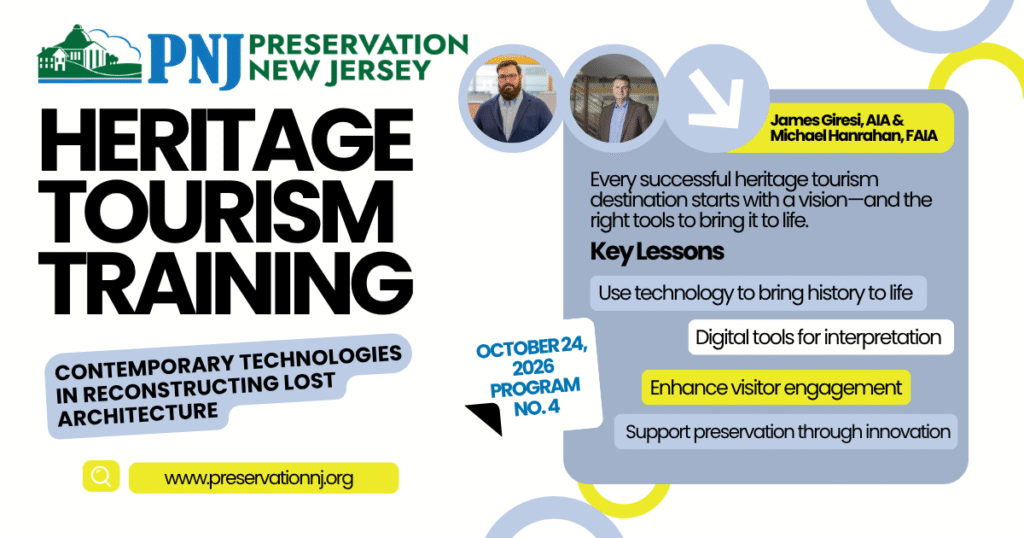
Program 4: Contemporary Technologies in Reconstructing Lost Architecture
Speaker/Program Moderator: James Giresi, AIA and Michael Hanrahan, FAIA of Clarke Caton Hintz
Session Description:
Lambert Castle, constructed in 1892 as the residence and showcase of silk manufacturer Catholina Lambert, originally spanned a 53-acre estate featuring the mansion, a north wing art gallery, a gatehouse, a carriage-greenhouse complex, formal Italianate gardens, and an observation tower. Today, only the castle, carriage house, and tower remain. The Castle underwent a significant seven-million-dollar restoration in 2022 and reopened to the public in January 2026. Earlier renovations in the 1930s included alterations to the castle, during which the original marble mantle and carved cartouche memorializing Lambert’s daughter were removed. The ornate marble cartouche, nearly 4 feet tall, could not be replicated due to the scarcity and expense of stone, leading to the use of alternative materials to reinterpret this historic element.
From its inception, Lambert employed innovative materials and techniques to realize his eclectic vision for the Castle. Features such as faux bois railings and serpentine scagliola columns in the foyer exemplified his creative use of technology to replicate exotic materials. This legacy inspired the approach to recreating the cartouche. Beginning with a block of clay, the artist developed maquettes to study the intricate carvings. Once finalized, the full-scale clay model was 3D scanned to produce a digital replica. High-density foam was CNC routed from the digital model, coated with plaster, and finished to match the original palette. This approach preserved the Castle’s grandeur while honoring its tradition of inventive material use.
As part of ongoing restoration efforts, Passaic County and Clarke Caton Hintz explored reconstructing the former North Wing, which had served as an art gallery for Lambert’s celebrated collection. Limited historic documentation—primarily photographs—and the high cost of physical reconstruction presented challenges. To address these obstacles, the team developed an innovative digital solution: an interactive virtual reality (VR) experience of the North Wing. Visitors can virtually “walk through” the historic gardens and art gallery, engaging with the artwork to learn more about each piece, its artist, and its provenance. Detailed auction records from nearly a century ago enabled the accurate representation of the original artwork in the virtual gallery.
This immersive digital interpretation enhances visitor engagement, expands accessibility, and extends Lambert Castle’s reach to audiences worldwide. By combining historic research with emerging technologies, the project demonstrates how heritage tourism programs can preserve and interpret historic sites while offering compelling, interactive experiences for contemporary audiences.
Learning Objectives:
- Engage public audiences with historic narratives using innovative and creative technological tools.
- Utilize emerging technologies to understand historic experiences, narratives, and the built environment.
- Analyze and interpret historic building materials through digital methods to document, diagnose, and design interventions for preservation.
This program is sponsored by the New Jersey Historic Trust.
Event Registration
Preservation New Jersey Members Attend FREE!
Current Preservation New Jersey members receive complimentary admission to this event. To reserve your spot, please email info@preservationnj.org to receive your member reservation code.
Not yet a member? Join Preservation New Jersey today and enjoy this event free, along with other exclusive member benefits. Become a member here: https://preservationnj.org/product/membership/