
- August 22, 2026
- William Michelson
Behind Kittatinny Mountain lies a remote, timeless, and utterly historic region of New Jersey, part of the Great Valley, a 1,200-mile-long geologic feature of North America. In a tiny village called Calno, in a part of Hardwick Township, Warren County, can be found an early 18th century stone house. It sits just off the Old Mine Road, which runs 40 miles from the Delaware Water Gap to the New York State line near Port Jervis, parallel to the Delaware River, but on higher ground. Trversing the Valley, the road was designed to reach navigable points on the Delaware River on one end, and the Hudson River at Kingston, New York, on the other. Much of the New Jersey portion has been designated as the Old Mine Road Historic District, which encompasses this house. Today, some of the farmland through which the road passed remains, but much of the area was never farmed, or has reverted to deep woodland. This is one of New Jersey’s must-see routes, especially during fall color season.
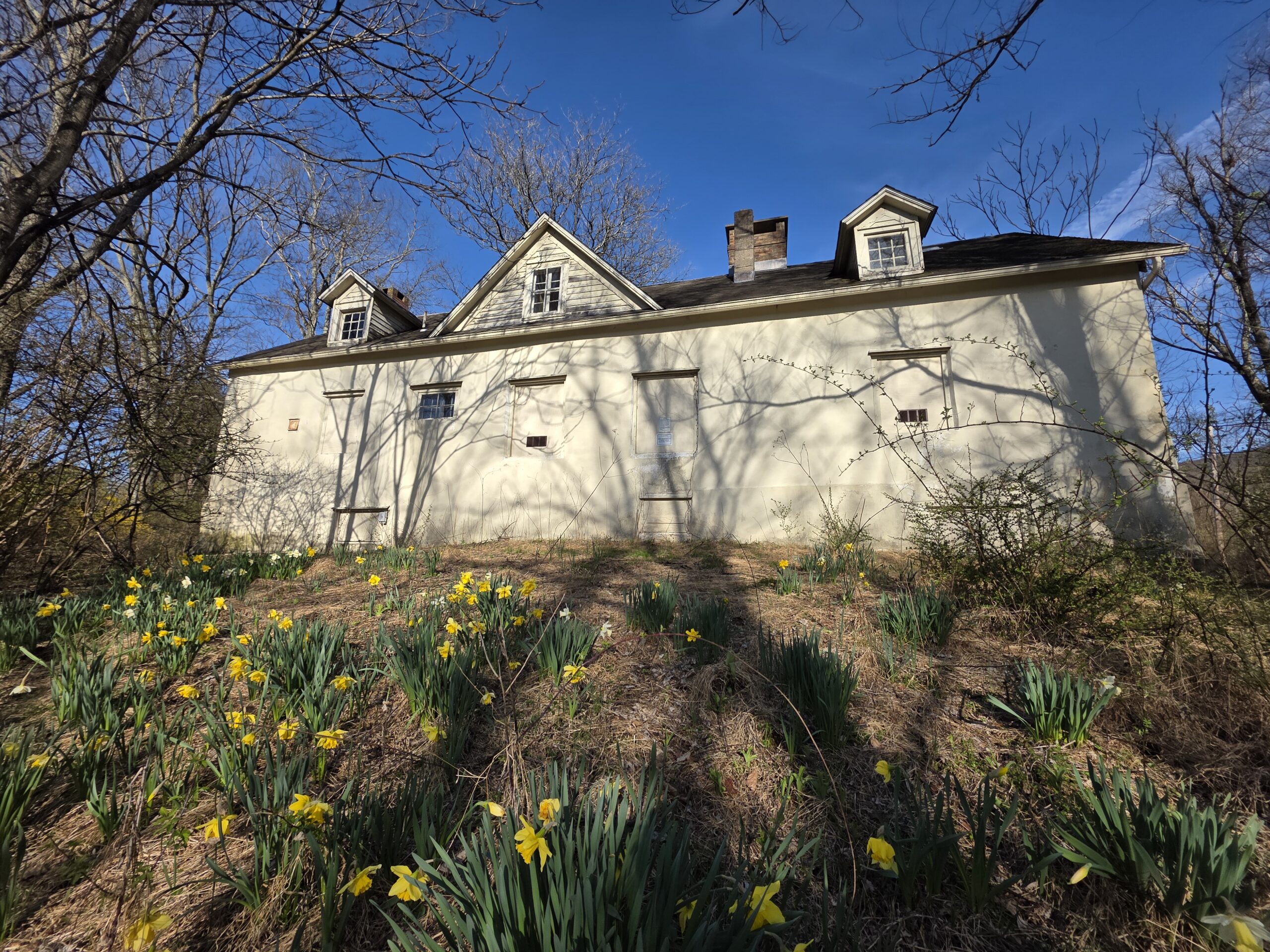
The 1½ story main house was built sometime between 1725 and 1735 by Abraham Van Campen, head of a family that also built at least four other historic homes in the vicinity, making name confusion easy. Born in 1698, he served as a Justice of the Peace, and served in the French & Indian War as a Colonel. It was at that time, around 1756, that the New Jersey colonial government ordered about a dozen small forts built in the Upper Delaware and Minisink Valleys, one of which is part of this site. Van Campen’s grand-nephew, Moses Van Campen, became a locally famous soldier in the Revolutionary War, when this area was still on the frontier of the wilderness.
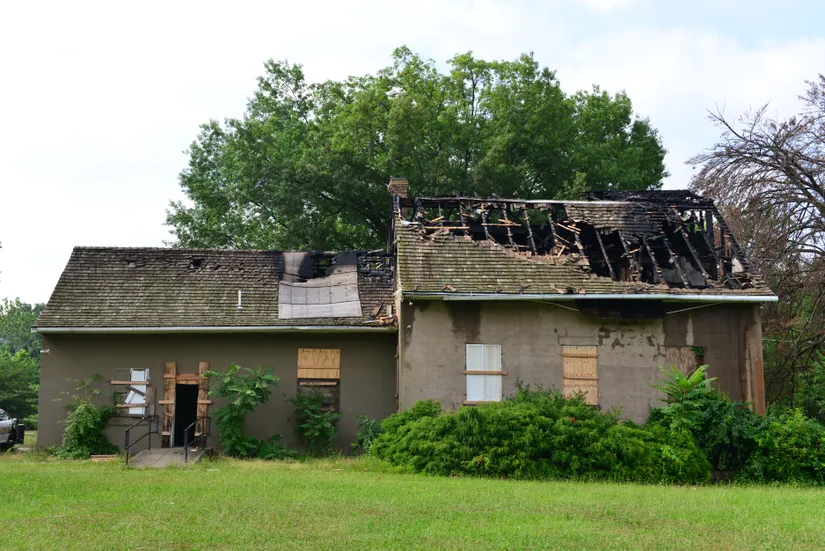
The main house is made of local red sandstone, which was covered over with white stucco about 100 years later. It still retains several significant interior features, including large arched fireplaces, exposed ceilings with wide-spaced beaded joists, wide plank floors of varying width, and colonial-style hardware, including door hinges and hooks. It is believed that part of the basement served as quarters for enslaved persons. It was nominated to the National Register of Historic Places in 1980, and was inhabited until 2006, so it has two bathrooms, electricity, and a heating system, none of which are currently in working order. Abandoned for a decade, it is now owned by the National Park Service. it suffers from neglect, such as moisture intrusion, insect infestation, rotting wood members, and poor drainage. It needs a new asphalt roof, two new doors, and modernized electrical service. There is also a barn and what was known as the Calno Cemetery, which has 157 burials, many being members of Van Campen family over a span of 250-plus years, with gravestones dating to the late 1700s.
Another structure close by, the Benjamin Van Campen house, dates from about 1840. It is a two-story clapboard gable-end house, with textured slate on one side, set on a rough fieldstone foundation. The site includes another barn with hand-hewn beams, and across the street are the foundations of a stone fort. The house needs some structural reinforcement on its northeast side. The rear porch was partially removed at some point, and now exhibits water damage. This house was still inhabited until the 1980s, and received some repairs in 2000. Both houses and barns need more routine repairs, such as clearing of intrusive trees and vines, and new interpretive signs.
The preservation challenge is rooted in that the whole area was taken over by the National Parks Service starting in 1965, and became part of the Delaware Water Gap National Recreation Area. This was originally done in tandem with the projected Tocks Island Dam, but that controversial plan never went forward, being cancelled by Congress in 1992. By that time, the federal government had acquired nearly all the land in the area, causing it to become almost totally depopulated. The site was in what was known as Pahaquarry Township, which was always small to begin with—the peak population in 1860 was around 460 residents. A hundred years later in 1960, the number had dwindled to 63. By the 1990s, there were too few residents to run the local government to even dissolve itself. The New Jersey State Legislature had to step in and disincorporate it in 1997.
Hence, there is no one to live in and maintain the Van Campen houses today, nor several others in the area. Keeping the structures up and viable has not received adequate federal budget dollars, and is not a National Parks Service priority. The Recreation Area now has a deferred maintenance backlog, which the NPS itself estimated at $161,000,000 in a 2022 report, $59,000,000 of it for buildings.
The Recreation Area still exists, however, and draws more than 4,000,000 visitors a year, who hike (the Appalachian Trail runs just above the site), kayak, raft, drive through, and simply enjoy both nature and history. In fact, it has been proposed to upgrade the whole area into a National Park, however, there is no assurance this will ever happen.
Local advocates, including descendants of the Van Campens, have formed a grassroots preservation partnership with an existing entity, Friends of the Delaware Water Gap, and are trying to raise funds to repair and restore the Abraham Van Campen Homestead. It is to assist this effort that Preservation New Jersey listed this group of buildings as one of its 10 Most Endangered Historic Sites for 2026, to draw attention to this worthy preservation project. Hopefully visitors can continue to enjoy the living history of the Van Campen Homestead, and several other remaining historic sites along the Old Mine Road.