

- August 29, 2026
- Darren Tobia
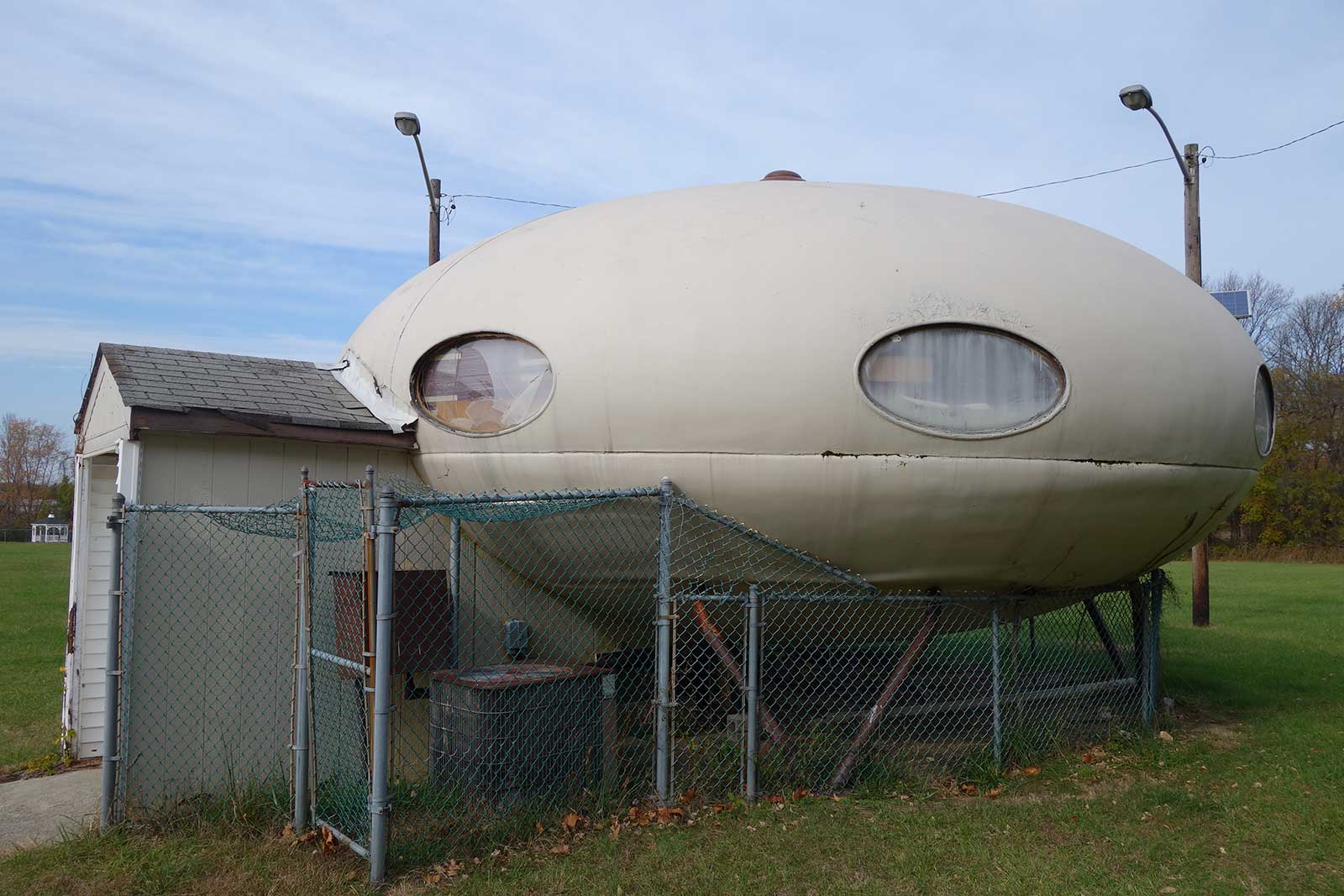
Last year, the New Jersey Historic Trust awarded a $39,465 grant to the Willingboro town government to author a long-awaited plan to preserve the Futuro House and a nomination for the National Register.
“This is the first step towards refurbishing it because it’s been sitting in the park all these years just deteriorating,” said Patricia Lindsay-Harvey, Willingboro Community Development Corporation, which is managing the grant on behalf of the town government. “And given that there’s not many left in this country, we have a chance to have a real landmark that makes Willingboro a destination for people to come see.”
The Futuro House — a whimsical flying saucer-shaped building about 26 feet wide — was one of about 100 of its kind. A Finnish architect named Matti Suuronen designed and manufactured them beginning in the 1968 to use as portable ski chalets. There are only 18 of them known to remain in the United States. One reason so few are left is that Suuronen used unorthodox materials, including plastic and fiberglass, which can be tricky to maintain and renovate.
However, if the National Register nomination goes as planned — in 2023, the State Historic Preservation Office deemed it eligible for that distinction — the town government could apply for special grants and tax credits to put toward a restoration.
“I don’t use the word unique very often, but they were unique pieces of modern architecture,” said Douglas McVarish, the historian who is authoring the National Register nomination. “There have been other attempts to build houses out of plastic or fiberglass, but not very many. So the materials make it significant.”
Another interesting fact about the Futuro House’s design is that it wasn’t intended to resemble a flying saucer — it was shaped that way for portability. But its resemblance to the ones depicted in science fiction of that era has taken on a life of its own.
When it arrived in Willingboro in 1973, the bank that owned it at the time played into its UFO appearance. On the day a helicopter lowered it to a parking lot on Route 130, tellers were costumed as astronauts. The moon landing had happened a few years prior in 1969 so visitors received phonograph copies of Walter Cronkite’s moon landing announcement.
However, the property, now owned by Willingboro town government, has been abandoned for decades. In 2020, it was listed as one of Preservation New Jersey’s most endangered places. Since then, town officials considered the idea of the Futuro House becoming a visitors center after hosting a focus group in 2023. But the issue was never settled. Its future use could be more clear after the preservation plan is completed.
“What I’m being hired to do is a preservation plan and feasibility study,” said Margaret Westfield, who was brought on to aid with the restoration. “So it does have that added chapter in there that looks at potential uses for the building.”
Westfield’s firm Westfield Architects & Preservation Consultants was a natural choice for the task having drafted the preservation plan that ended up saving a 1866 schoolhouse in Willingboro. The Futuro House also shares a similarity with another New Jersey landmark that Westfield has been working on since 1991 — the restoration project for Lucy the Elephant in Margate. Both are considered “architectural follies,” buildings that don’t serve a practical purpose.
Lucy the Elephant is a reminder that a single landmark can be a boon for local tourism. The attraction brings about 25,000 visitors to Margate who may not have visited otherwise.
“It’s reached the point where somebody needs to step in and do something or the Futuro House is going to be lost forever,” Westfield said. “That would be a terrible tragedy because there are so few of these buildings still surviving throughout the world.”



Linda
| 30 August 2026I believe there was a future house on Long Beach Island, in Harvey Cedars. I was wondering if maybe this was the same one? Thank you.