
- October 10, 2026
- William Michelson
Where Interstate 80 crosses the Delaware River into Monroe County, Pennsylvania, the highway must thread through a narrow section of the famous Delaware Water Gap, where the river cuts through Kittatinny Mountain. The ridge, which becomes Blue Mountain in Pennsylvania and continues south as part of the Blue Ridge Mountains, rises approximately 1,200 feet above the river. At Mount Tammany, sheer rock faces rise dramatically above the highway and river. Rock, trees, and debris occasionally break loose from these steep slopes and fall toward the transportation corridor below.
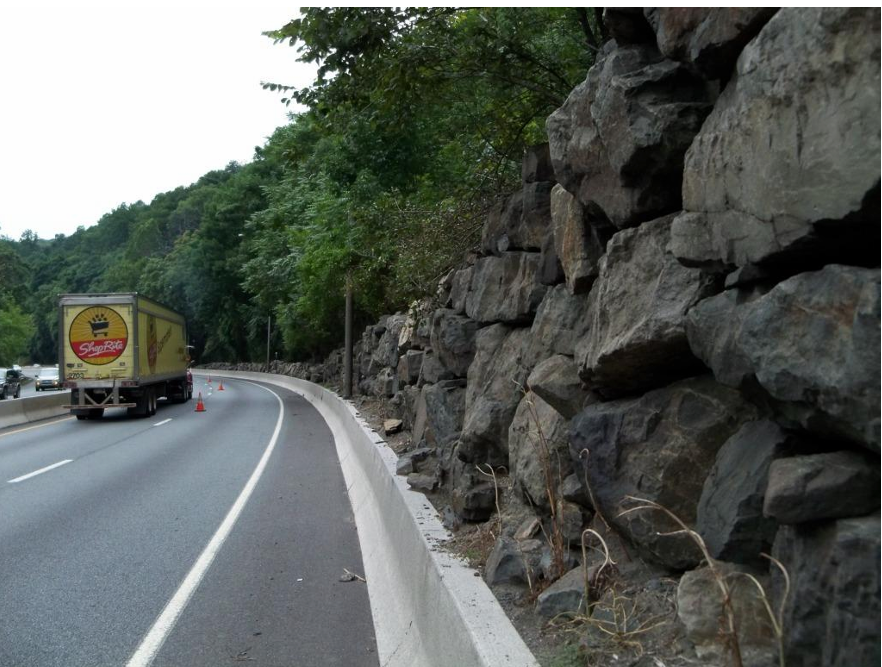
The narrow strip of land now occupied by Interstate 80 previously carried the double-track main line of the New York, Susquehanna & Western Railway. Beginning in the 1880s, the “Suskie” constructed a low stacked-stone barrier along the landward side of its right-of-way to help contain material falling from the mountainside. Much of this railroad-era wall survived when the New Jersey Department of Transportation constructed the present highway in the 1950s. Nearby was once the railroad station of Dunnfield, close to the point where the historic Old Mine Road turns northeast.
Today, traffic volumes and highway safety requirements are dramatically different from those of the railroad era. NJDOT has identified this section of I-80 as the state’s highest-ranked rockfall hazard area. The four-lane highway carries approximately 51,000 vehicles each day, while the historic wall stands only two to four feet high and consists of unmortared stone. Remarkably, after approximately 140 years, substantial portions remain intact.
NJDOT reports that falling rocks and debris have occasionally damaged the highway or contributed to accidents, and the roadway has required closures for rock and branch removal, particularly after rain and snow destabilize the slope. The most heavily protected section currently contains a gabion wall—a steel mesh structure filled with stone—which dates to the early 1970s. In other areas, however, the historic stacked-stone barrier remains the principal surviving feature along the base of the slope.
NJDOT’s preferred alternative calls for a concrete barrier curb ranging from 42 to 72 inches in height, with sacrificial timber lagging attached to the rear to absorb the energy of falling rocks. Other alternatives studied have included blasting portions of the rock face to create additional catchment space, installing steel rockfall fences ranging from approximately 10 to 50 feet high, and constructing a protective shed over the roadway that would function much like a short tunnel.
None of the alternatives studied appear to prioritize retaining the historic stacked-stone wall in place. NJDOT has instead proposed removing it and replacing it with a new stone-faced or concrete barrier, accompanied in some locations by fencing extending approximately 25 to 30 feet above roadway level.
That raises an important preservation question: Can modern highway safety improvements be designed while retaining this surviving piece of nineteenth-century transportation infrastructure?
From a historic and aesthetic standpoint, there are several possibilities worth further consideration. Could portions of the original wall remain in place? Could new protective infrastructure be positioned behind it, allowing the historic feature to remain visible? Could different sections of the approximately 2,000-foot-long project area receive different treatments based on their particular safety conditions, historic integrity, and visibility from the highway, Appalachian Trail, Delaware River, and surrounding landscape?
These questions are particularly important because the wall is more than an old roadside feature. Its “gravity masonry construction with a battered profile” represents an early form of rockfall mitigation engineering associated with the railroad era. As Tara Mezzanotte of the Knowlton Township Historic Commission noted in the nomination submitted to Preservation New Jersey, the wall contributes to the historic character and visual continuity of a corridor experienced from roadway, trail, river, and rail vantage points—a “layered transportation landscape.”
Public outreach through the federal Section 106 review process has already resulted in meetings, presentations, and discussion among interested parties. Participants have included the Delaware River Greenway Partnership, the New Jersey and Pennsylvania State Historic Preservation Offices, the Knowlton Township Historic Commission, and the Warren County Division of Cultural Affairs. The larger I-80 Delaware Water Gap Coalition has also organized around the project and maintains an active public presence.
The project has not yet begun, and major construction has not been funded, although routine rock and debris removal continues when necessary. This provides an important opportunity for additional consultation before irreversible decisions are made.
Section 106 is intended to provide precisely this kind of opportunity: identifying historic resources, evaluating potential effects, and bringing agencies, preservation organizations, local governments, and the public into the conversation before federally involved projects move forward. Safety must remain a central consideration in a corridor with documented rockfall hazards, but safety and preservation do not necessarily have to be treated as mutually exclusive goals.
Preservation New Jersey has therefore named the I-80 Stacked Stone Barrier at the Delaware Water Gap one of New Jersey’s 10 Most Endangered Historic Places. Its designation calls attention not only to the potential loss of a 140-year-old railroad engineering feature, but also to the broader question of how modern infrastructure projects can accommodate historic resources within landscapes that have evolved over generations.
PNJ supports continued evaluation, consultation, and exploration of feasible design alternatives that address public safety while preserving as much of the historic wall and its visual relationship to the Delaware Water Gap as reasonably possible. With thoughtful planning, the next layer of this transportation landscape does not necessarily have to erase the ones that came before it.