- November 7, 2026
- Greg Fitzgerald
In January, an “unsafe structure” sticker went up on the Asbury Park Casino, and its owner, Madison Marquette, sought a permit to demolish the historic breezeway at the heart of the building. Ten months later, the wrecking ball has been held off, but little else has changed. The breezeway is still closed, and the legal path to rescuing the building is still in dispute. What has changed is who is watching: a grassroots group, Save Our Structures – Asbury Park (SOS-AP), has spent the year making sure the Casino never drops off City Hall’s agenda.
In May, Preservation New Jersey named the Casino to its 2026 list of the 10 Most Endangered Historic Places in New Jersey, urging city officials to pursue legal avenues to protect and adaptively reuse it. It isn’t the building’s first appearance – the Casino was on our 1996 list, too, and the thirty years since have been a story of promises made and not kept.
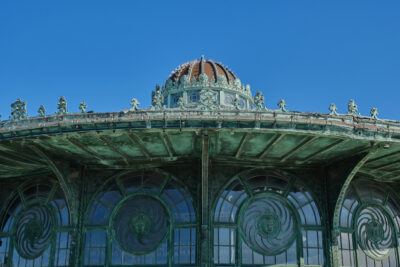
Built between 1928 and 1930 to designs drawn by Warren and Wetmore, the firm behind Grand Central Terminal and Asbury Park’s own Convention Hall, the Casino has anchored the south end of the boardwalk for nearly a century. The passageway through the center – also known as the breezeway or the Grand Concourse – has long been a vital pedestrian link between Asbury Park and Ocean Grove.
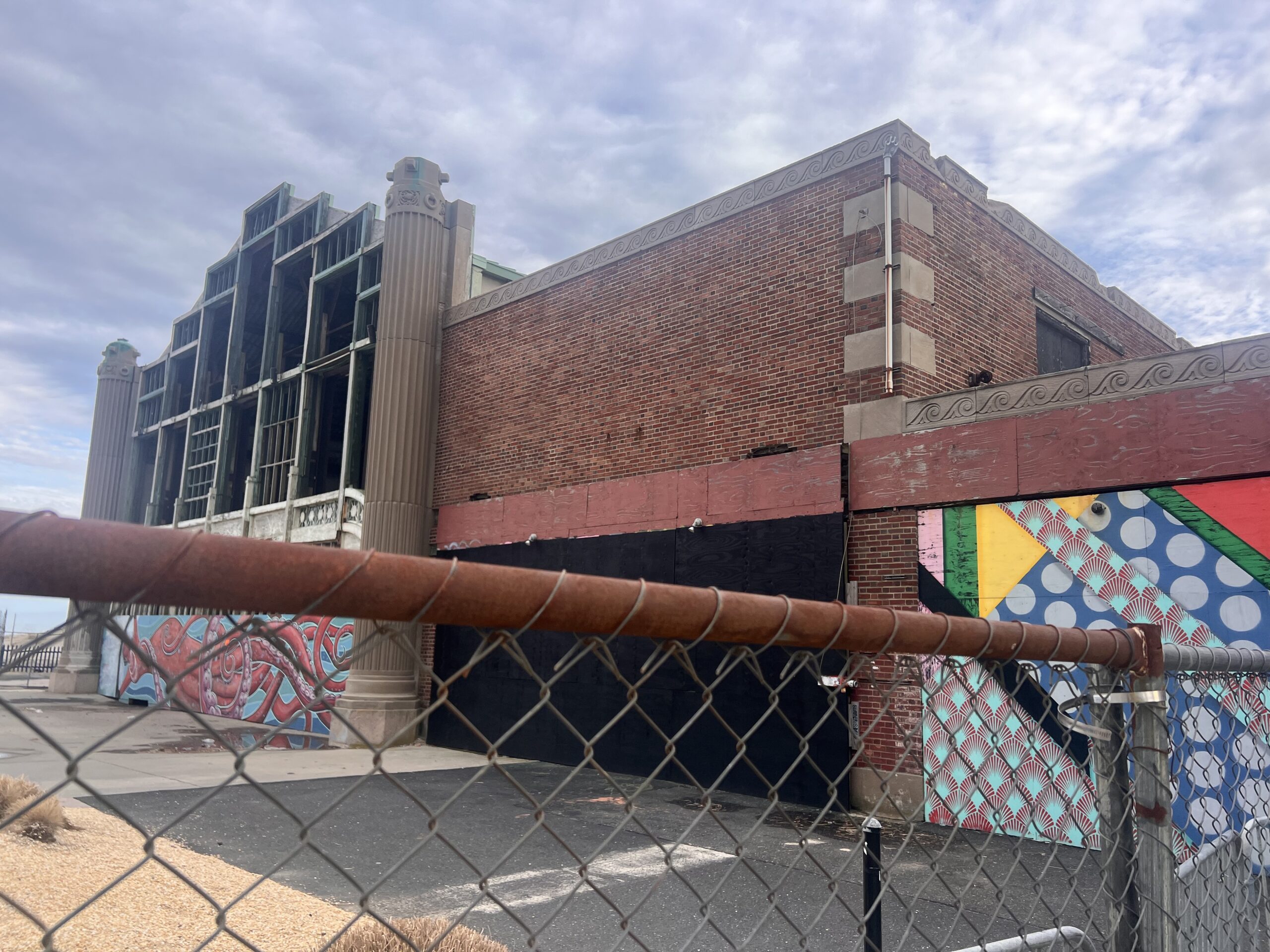
The amusements in the Casino closed after the 1990 season, the eastern section on the beachfront was demolished in 2006, and the breezeway was shut in May 2023 after an inspection found its steel roof trusses were suffering from corrosion. In early 2026, an “unsafe structure” notice was slapped on the building, and another piece of the structure looked set to follow the eastern section into history.
Facing public outrage and letters from Senator Vin Gopal and Assemblywomen Margie Donlon and Luanne Peterpaul, Madison Marquette reversed course on February 6, the day before a planned rally on the boardwalk, and announced that the breezeway would be “repaired and preserved.” Roof repairs were finished in March, and the outdoor pathway along the east side of the building reopened to pedestrians and cyclists – reconnecting Asbury Park and Ocean Grove. The interior breezeway remains closed, with no public timeline for its restoration.
That is why the Casino is on the 10 Most list. A pledge is not a plan, and the building is becoming a textbook example of demolition by neglect.
In March, the City Council hired retired New Jersey Supreme Court Justice Lee A. Solomon, of Archer & Greiner, for $20,000 to answer a question pressed by residents and by attorney Thomas De Seno, who submitted a nearly 900-page brief on it: can Asbury Park take the Casino back?
In his April 23 opinion, Solomon agreed that the Casino and neighboring Power Plant are still governed by the 2002 redevelopment agreement with Asbury Partners, not the 2010 agreement with Madison Marquette that covers Convention Hall. Under the 2002 contract, he found, the City’s remedies for a default include repurchasing the Casino, seeking an injunction, suing to cure the default, and terminating the developer’s rights in the property. According to SOS-AP, the repurchase price is the $1.5 million the developer originally paid.
Then a third document entered the picture: a 2006 Dispute Resolution Agreement covering roughly $1.3 million in asbestos removal and repairs. In a May 28 addendum, Solomon found that this work was largely complete and could no longer be grounds for a default. But he added that if any other redevelopment obligations under the 2002 agreement remained outstanding, the 2002 remedies would still apply. Whether such obligations exist, he said, was outside the scope of what he had been asked to review.
When the City released the opinions on June 10, it declared that reclaiming the Casino was “not a viable path,” a conclusion shared by its redevelopment counsel, Joseph Maraziti.
De Seno and SOS-AP say that reading gets Solomon backwards. They point to a 2004 report by Clarke Caton Hintz, prepared under Section 3.5 of the 2002 agreement, which laid out about $33.6 million in rehabilitation work on the Casino on a 2004–2007 schedule. That work, they say, was never done, and those are exactly the “remaining obligations” that keep the City’s remedies alive.
The City’s position is that the 2010 agreement requires entirely new development agreements for the Casino and Power Plant before any construction obligation can arise. At a packed July 8 meeting, Maraziti conceded that Solomon had agreed with De Seno’s first argument, said that was “not the end of the story,” and maintained that a lawsuit was not plausible.
Since July, the City’s approach has been to wait, holding off on litigation while Madison Marquette sought state funding for Convention Hall. In August, the New Jersey Economic Development Authority approved up to $75 million in tax credits toward a $130 million restoration of Convention Hall and the Paramount Theatre.
On August 19, the Council created a Casino Property Advisory Committee to recommend how to maintain, restore, and improve the Casino, Carousel House, steam plant, and breezeway. Its five members, announced September 23, are Councilwomen Eileen Chapman and Yvonne Clayton, SOS-AP co-founder Celia Morrissette, Todd Gordon, and William Acevedo. Its written report is due in six to nine months.
A preservation advocate at the table is a real step forward, and SOS-AP has welcomed it. But that report isn’t due until the spring of 2027, and the Casino faces yet another winter on the seafront, taking the brunt of the Atlantic air.
SOS-AP was founded by four local advocates, Dave Henry, Celia Morrissette, Kris Ohleth and Kristin O’Meara, after a special Council meeting at Asbury Park High School in February. It is volunteer-run and independent of any other Casino or boardwalk fundraising effort.
Its first priority, which it calls “Job One,” is the space Madison Marquette calls the breezeway. SOS-AP calls it the Grand Concourse, and the name is deliberate. “Calling it a ‘breezeway’ makes it sound like an afterthought,” a spokesperson told The Coaster. The group wants binding commitments that the Casino will be:
- treated as a historic resource, keeping its arches, ornament and open passageway;
- adaptively reused in ways that welcome the public, through arts, culture, small businesses or community space, rather than walled off or privatized; and
- restored on clear milestones, with real community input, so residents can hold the City and the developer to them.
Its longer goal reaches past the boardwalk: a Historic Preservation Commission with the power to identify significant buildings and review demolition and construction proposals before they happen. Asbury Park does not have one.
The group’s method is showing up. It packed the July 8 meeting, which drew more than 200 people, after holding a webinar with De Seno to help residents prepare. Its website offers a sample letter to the Council and help for anyone who wants to testify. In May, it became the Preservation Committee of the Asbury Park Historical Society, chaired by Ohleth. It is also working with state and national preservation groups to find examples of neglected landmarks that other cities have brought back, and Preservation New Jersey is helping it tell the Casino’s story through feature stories and public programs.
Thirty years after it first appeared on our list, the Asbury Park Casino is still standing. Whether it is standing thirty years from now depends on decisions that will be made in the next few months, and on who is in the room when they are made.