

- April 10, 2026
- Kelly C. Ruffel
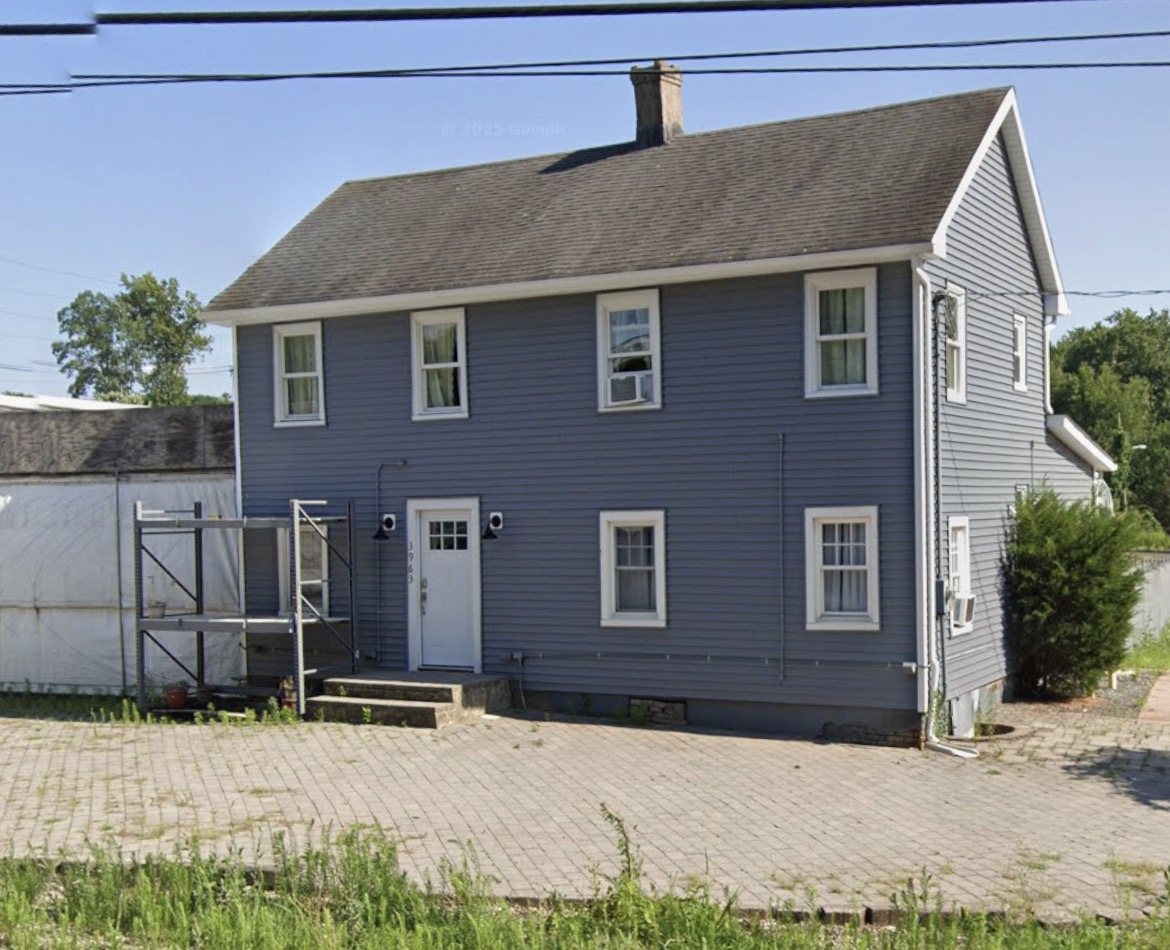
Last year, Richard Pucciarelli, a member of Old Bridge’s Historic Preservation Commission, woke up to the devastating news that a 19th-century home in town had been suddenly demolished.
But the fallout has turned into a much larger issue that has left him questioning the commission’s entire existence.
Pucciarelli believes that the circa 1890 Bennett House was a locally designated landmark and should have come to his commission for approval. In fact in 2024, the developer — Vision Old Bridge, LLC — did appear before his commission to discuss plans to build a three-story apartment building on the site.
“They wanted our blessing and we said, ‘No you have to follow the local ordinance in town if you want to demolish that structure,” he said.
Pucciarelli argues that the Bennett House is considered a landmark through its inclusion on a 1982 report called the New Jersey Historic Sites Survey.
Other than a brief appearance at the Zoning Board last year, when the developer’s application was adjourned, that was the last Pucciarelli had heard on the matter. Then came the demolition on Sept. 16, which happened conveniently on the day of a Town Council meeting. Pucciarelli appeared at the public comment portion at which he decried the untimely “death” of the Bennett House.
At the time, no one on the Town Council had heard about the demolition. But the following month Nicole Shapiro, the township engineer, made a lengthy report to the Town Council about the demolition, claiming that, although it was listed in the 1982 Historic Sites Survey, it is not considered a local landmark.
In the end, Shapiro might be correct — in part. The township’s ordinance mentions that the commission can compile a list of historic properties. However, this inventory appears to be distinct from the Local Register, which lists only 25 landmarks, including the Elmer Warne House. The Bennett House is not on that list.
Steven Smolyn, an architectural historian and Preservation New Jersey board member, said that a survey listing is not enough for landmark designation. “Surveying is one of the first steps toward designation typically,” he said. “But designation as a local historic landmark, historic site, or historic district requires formal action by the governing body.”
But there is more concerning statement from Shapiro that doesn’t seem to hold much water. “They don’t have authorization to say someone cannot demo a building,” said Shapiro about the HPC.
This remark casts doubt on the HPC’s review authority concerning demolitions, not just at the Bennett House, but of all local landmarks in Old Bridge. However, the ordinance does state that demolition of properties on the Local Register requires “prior approval” from Old Bridge’s HPC.
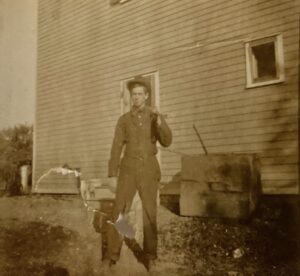
Bill Quint’s grandfather, David Fitzgerald, lived at the Bennett House from 1917 to 1919 when it was a working farm. Courtesy of Bill Quints.
Even if the property was never designated, it still holds historical value. Bill Quinn, the grandson of one of the home’s former owners, said the reason the century-old home was still standing is because the former stewards understood its importance. “It was great that the previous owners had been so respectful of the historic status of the structure,” Quinn said. “I talked to one of them and they said they understood it was historic and needed to preserve it.”
Quinn’s grandfather, David Fitzgerald, lived there with his wife, Mary, from 1917 to 1919 when the home was still an 11-acre working farm.
There could be a silver lining to all this. The Bennett House is gone for good. But this could be an opportunity to clear up ambiguity about designated local landmarks and the HPC’s legal right to protect them from demolition.
Even more, the frustration among local preservationists could be corralled into a larger movement for stronger safeguards. This is what happened in Maplewood when the 18th-century Fleming House was demolished in 2023. This led to the township passing a stronger historic preservation ordinance giving the HPC the authority to review the demolition of properties that are included in architectural surveys, even if they are not designated landmarks.
The developer, in the end, has put a glaring spotlight on his own proposal, which, after a series of adjournments, is scheduled to appear in June before the Zoning Board. Pucciarelli said he is now turning his advocacy toward a new cause. “The only thing the commission can do is to argue to deny the applicant all their variances,” Pucciarelli said. “That’s our goal.”


Peter Triestman
| 12 April 2026Regretting the legal demolition of the least of our historic patrimony, and then engaging in a vendetta against the developer, is not a wise use of our resources, time, taxpayer funds, and is likely illegal. Shame on Pucciarelli! He should resign.
Ken Roginski
| 12 April 2026This is not just sad news—it is a sobering reminder of how fragile historic preservation truly is.
A Historic Preservation Commission can create the illusion of protection, but in reality, it often offers little more than a false sense of security. This has played out before in Freehold Borough, where the commission itself was established only after significant historic buildings had already been lost, and out of fear that anything might threaten the town’s most prominent landmark, The American Hotel (1824).
Yet even with an HPC in place, the very outcome it was meant to prevent still occurred.
A code enforcement officer—one with a known pattern of disregarding historic significance—declared the building structurally unsound. There was no serious effort to consult an engineer experienced in historic structures, despite the well-established fact that such professionals routinely stabilize and repair buildings far more compromised than this. Instead, the decision was made swiftly, and the building was demolished.
What replaced it is a hollow imitation. To the untrained eye, it may pass as “historic,” but in truth it is nothing more than a stage set—a contrived reproduction lacking authenticity, proportion, and integrity. The reproduction was designed by an architect and member of the HPC. Details such as a tin porch ceiling, ill-conceived shutters, and incorrect window proportions betray its true nature. It is not preservation; it is fabrication. A theme-park version of history.
While the retirement of that particular code enforcement officer is a relief, it should not be mistaken for progress or safety. The underlying problem remains. A commission, no matter how well-intentioned, is only as effective as the individuals making decisions and the vigilance of the community supporting it.
This is why situations like this—and similar ones in Old Bridge—must be studied carefully. They reveal an uncomfortable truth: laws and commissions cannot always be depended on to protect historic buildings. And when those people lack understanding, conviction, or respect for historic fabric, the outcome is predictable.
The lesson is clear. We cannot assume protection simply because a framework exists. Developers, opportunists, and even officials will continue to test the limits. Complacency is the greatest threat. If we value our historic buildings, we must remain informed, engaged, and ready to challenge decisions the moment they arise—not after the damage is done. I am so sorry for the loss in Old Bridge but let us all learn from this and stay alert.