

- May 14, 2026
- Kelly C. Ruffel
From the Jersey Shore to the Delaware Water Gap, Threatened Sites Span the State’s Architectural, Cultural, and Revolutionary War Heritage
Red Bank, NJ — On Wednesday, May 13, at the Monmouth Boat Club in Red Bank, Preservation New Jersey (PNJ) announced its 2026 list of the 10 Most Endangered Historic Places in New Jersey, elevating a statewide call to protect the historic, cultural, architectural, and archaeological resources that define New Jersey’s identity and collective memory. More than 55 advocates gathered not simply to recognize endangered places, but to confront the growing reality that the systems designed to protect history are themselves increasingly at risk.
Paul Muir, President of PNJ, reflected that “this year’s list reflects the breadth of what is at stake: a beloved Shore landmark facing a demolition permit, a Civil War survivor’s homestead slated for a gas station, colonial-era roads disappearing into the Pinelands, and a Newark building that hosted the Black Power Conference now threatened by a parking lot. These places are not relics, they are living connections to who we are. We are calling on property owners, municipalities, developers, and the public to join us in finding solutions that preserve these irreplaceable resources for future generations.”
Now in its 31st year, the 10 Most Endangered Historic Places program continues to spotlight the urgent threats facing New Jersey’s historic resources, from demolition and deferred maintenance to unchecked redevelopment pressures, climate impacts, disinvestment, and the lack of sustainable preservation funding. Yet the program also reinforces a broader truth: historic preservation is not about nostalgia. It is about safeguarding the physical places that tell the story of who we are, where we came from, and what communities choose to value for future generations.
The 2026 list includes:
- 1878 Barn — Ringoes (Hunterdon County)
- Asbury Park Casino — Asbury Park (Monmouth County)
- Cathedral House — Newark (Essex County)
- Cooper House — Hope Township (Warren County)
- Historic South Jersey Roads — Atlantic, Burlington, and Camden Counties
- Stacked Stone Rock Slide Barrier — Knowlton Township (Warren County)
- Former Lord Stirling School — Basking Ridge (Somerset County)
- Van Campen Homestead — Hardwick Township (Warren County)
- Burroughs/Van Wagoner House — Hopewell Township (Mercer County)
- Worden House — Lacey Township (Ocean County)
The evening emphasized that historic preservation remains one of the most effective tools for strengthening communities. Preservation supports economic revitalization, heritage tourism, environmental sustainability, downtown investment, small business development, housing reuse, and educational engagement. Historic places anchor neighborhoods, connect residents to shared stories, and provide tangible evidence of New Jersey’s diverse cultural, industrial, agricultural, and civic history.
At the same time, we are warned that preservation itself faces a defining moment. The proposed federal fiscal budget currently is proposing to drastically underfund the Historic Preservation Fund (again) while reducing or eliminating many preservation-related programs that communities rely upon for planning, rehabilitation, archaeology, and stewardship efforts. These cuts threaten not only individual buildings and landscapes, but the long-term capacity of communities nationwide to preserve and interpret their own history.
As the nation approaches the 250th anniversary of the United States in 2026, advocates are challenging policymakers and the public alike to consider what meaningful commemoration truly requires. Anniversaries alone cannot preserve history. If the places connected to the Revolutionary War, labor movements, transportation networks, civil rights struggles, immigrant communities, and everyday American life are allowed to disappear, future generations will inherit celebrations without context and memory without place.
And more importantly, as New Jersey prepares to participate in the nation’s semiquincentennial observance, Preservation New Jersey and preservation advocates across the state underscored a fundamental question: how can the country encourage Americans to value and understand history while simultaneously dismantling the very programs designed to protect it?
There needs to be a renewed call for action and partnership among government agencies, nonprofits, private stakeholders, and local communities to ensure historic preservation remains central to conversations about infrastructure, economic development, sustainability, and public policy. As preservation leaders, we need to stress that saving historic places is not solely about protecting the past — it is an investment in civic identity, community continuity, and the stories future generations will inherit.
2026 Endangered Site Summaries
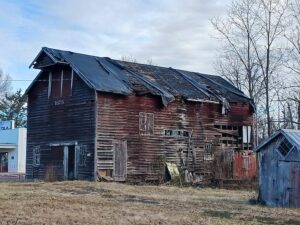 1878 Barn, Ringoes (Hunterdon County) The last surviving pre-modern barn in the village of Ringoes, this two-story timber-frame structure sits at the heart of a rare surviving house-and-barn pairing along the historic Old York Road, once an Indigenous trail and vital colonial transportation corridor. Its hand-laid fieldstone foundation, heavy timber framing, and historic details make it one of the most intact examples of Hunterdon County’s agricultural heritage. The barn now faces imminent collapse due to severe neglect, a failing roof, and a deteriorating foundation. Advocates fear demolition or loss to structural failure if stabilization does not occur quickly.
Asbury Park Casino, Asbury Park (Monmouth County) Constructed between 1928 and 1930 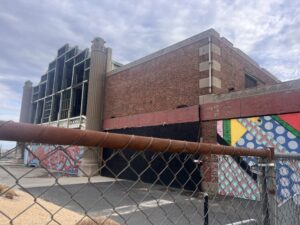 and designed by the architects of Grand Central Terminal, Whitney Warren and Charles Wetmore, the Asbury Park Casino is one of New Jersey’s most iconic waterfront landmarks. Its Beaux-Arts grandeur, green roofline, and monumental arches have made it synonymous with the Jersey Shore’s cultural identity, appearing in art, photography, film, and music, including references in Bruce Springsteen’s work and the 2025 biopic Deliver Me from Nowhere. Previously listed on PNJ’s 1996 “10 Most Endangered” list, the Casino is now facing a demolition permit filed in January 2026 by developer Madison Marquette following decades of neglect. The application has sparked widespread public outrage, packed city council meetings, more than 10,000 petition signatures, and the formation of advocacy group Save Our Structures Asbury Park (SOS-AP). Preservation New Jersey is relisting the Casino and urging city officials to pursue legal avenues to protect and adaptively reuse these irreplaceable landmarks.
Cathedral House, Newark (Essex County) At 24 Rector Street in Newark’s Military Park 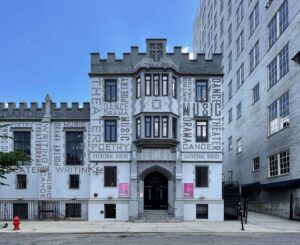 Commons Historic District, Cathedral House is a 1941 Collegiate Gothic masterpiece — the only known gothicizing work of acclaimed Newark architects John and Wilson Ely, distinguished by its crenellated parapets, pointed arches, cathedral windows, and dramatic central tower. The building has served as a site of extraordinary civic history: in 1967 it hosted the landmark National Black Power Conference, bringing together more than 1,000 activists in the weeks following the Newark Rebellion, and for decades it has served thousands of Newark youth through NJPAC arts education programs. Despite the building’s structural soundness and continued usability, the Newark Landmarks & Historic Preservation Commission approved demolition in 2026 to make way for a temporary pocket park and surface parking lot, a decision preservation advocates argue violates a legally binding 1993 Section 106 agreement requiring adaptive reuse. Preservation New Jersey calls on NJPAC and city officials to pursue alternatives that honor this landmark’s layered history and protect Newark’s architectural and civil rights heritage.
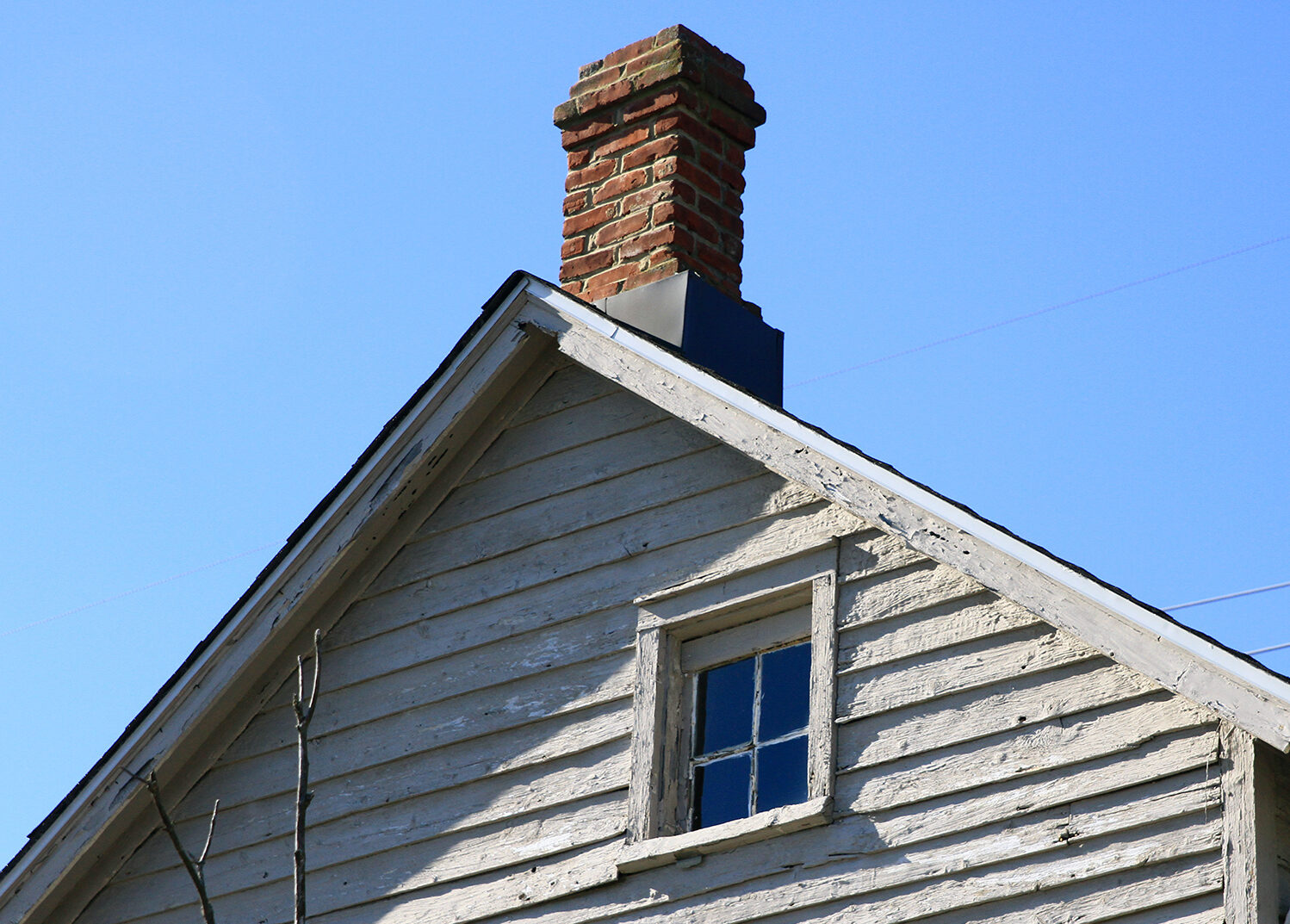
Cooper House, Hope Township (Warren County) The Cooper House on Hope-Bridgeville Road  is one of only three surviving frame structures built by the Moravians in Hope between 1769 and 1808, and a contributing resource within the nationally registered Hope Historic District. Constructed in stages beginning around 1770–1785, the dwelling retains exceptional integrity — heavy timber framing, wide plank flooring, original fireplaces, and evidence of traditional Germanic construction including mud and brick infill. Located on “Moravian Row” in one of only five Moravian communities established in the United States, the Cooper House faces serious structural deterioration from decades of neglect: a failing fieldstone foundation, deteriorated chimneys, sagging floor framing, insect damage, and rotting structural timbers. Nonprofit organization H.O.P.E. (Help Our Preservation Effort) purchased the property in 2025 with plans for restoration and adaptive reuse and is actively pursuing stabilization funding.
Historic South Jersey Roads (Atlantic, Burlington, and Camden Counties) The Pinelands 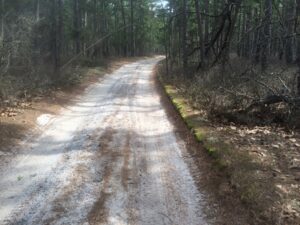 of South Jersey preserves an extraordinary network of Colonial and Revolutionary War-era roads including Tuckerton Stage Road, Batsto-Fireline Road, Quaker Bridge Road, Hampton Road, and Pleasant Mills Road — that remain largely intact in their original alignment and landscape setting. Documented routes traveled by George Washington, Nathanael Greene, Count Pulaski, and other prominent figures, these corridors served as vital arteries for iron production, maritime commerce, salt works, and military operations, and many are believed to originate as Indigenous trails predating European settlement. Despite their remarkable historic significance, the roads face growing threats from neglect, inconsistent maintenance, overgrowth, and lack of public awareness. Researchers and advocates are calling for formal historic designation, interpretive programming, and coordinated preservation planning to protect these living landscapes before they disappear.
Stacked Stone Rock Slide Barrier, Knowlton Township (Warren County) Visible from 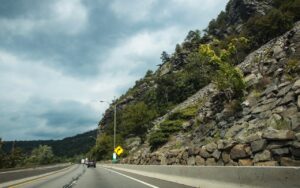 Interstate 80, hiking trails along the Appalachian Trail, and the Delaware River itself, this hand-laid masonry gravity retaining wall is a rare surviving example of 19th- to early 20th-century transportation engineering in the Delaware Water Gap believed to be a relic of the New York, Susquehanna & Western Railroad, constructed to protect tracks from rockfall at the base of Mount Tammany. NJDOT records confirm the wall predates Interstate 80. It now faces imminent demolition as part of a major NJDOT rockfall mitigation project, with plans to blast the mountainside and replace the historic structure with modern fencing. Preservation advocates argue that NJDOT has failed to fully evaluate the barrier’s historic and railroad-era significance before advancing demolition plans, and are calling for a full Environmental Impact Statement and transparent review of preservation-sensitive alternatives.
“If you have driven I-80 west through the Delaware Water Gap S-Curves, you have passed this massive wall — a half mile of hand-laid stone at the base of Mount Tammany, decades older than the Interstate itself. Likely built by the railroad, it is still doing its job today. NJDOT’s $200 million project would destroy it. We are not opposing rockfall mitigation — we support a safer corridor. We are asking for an independent National Register eligibility review, a full Environmental Impact Statement, and honest consideration of alternatives before the Delaware Water Gap loses an irreplaceable piece of its history,” stated by Tara Mezzanotte, Project Coordinator, Knowlton Township Historic Commission
Former Lord Stirling School, Basking Ridge (Somerset County) The 10.8-acre property at 99 Lord Stirling Road in Bernards Township was once part of the estate of Revolutionary War General William Alexander, Lord Stirling, a close advisor to George Washington. A 1770 estate map identifies the site as “The Garden,” potentially containing the residence of a master gardener and linked to the 1778 wedding of Lord Stirling’s daughter attended by Washington himself. Because the land has remained privately owned, it has never been archaeologically studied, but excavations at the adjacent Lord Stirling Manor site have uncovered colonial-era foundations and drainage systems, suggesting significant resources may lie beneath. Since the school closed in 2020, the property has changed ownership three times and deteriorated through neglect. The current owner is pursuing redevelopment designation for multifamily housing, which could permanently destroy unexamined archaeological resources of national significance.
Van Campen Homestead, Hardwick Township (Warren County) Few sites in New Jersey 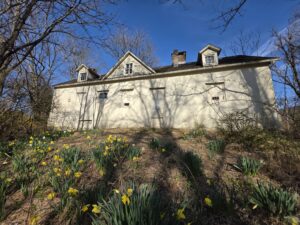 encompass as many layers of early colonial history as the Van Campen Homestead along Old Mine Road in the Delaware Water Gap National Recreation Area. Centered on the Abraham Van Campen House (circa 1725–1735), the property includes two dwellings, associated barns, family cemeteries, and the foundation of a French and Indian War-era fort and is listed within the Old Mine Road Historic District on the National Register of Historic Places. The homestead preserves rare colonial features including massive arched fireplaces, exposed beaded ceiling joists, and a basement believed to have housed enslaved individuals, while its broader history spans settlement, Indigenous relations, Revolutionary War service, and the Delaware River frontier. Despite its remarkable integrity, the property faces deteriorating conditions including moisture damage, insect infestation, roof failure, rotting structural members, and failing drainage systems, compounded by chronic underfunding of the National Park Service. Descendants and local advocates have formed a grassroots preservation partnership with Friends of DEWANPS to coordinate fundraising and restoration.
Burroughs/Van Wagoner House, Hopewell Township (Mercer County) Believed to date 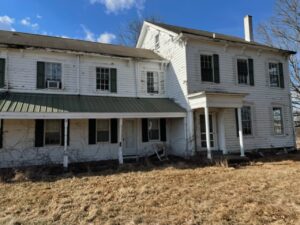 between 1800 and 1830, the Burroughs/Van Wagoner House is one of the last remaining visual connections to the historic rural character of Hopewell Township, a two-story Greek Revival dwelling with a grand staircase, marble mantels, distinctive Egyptoid window casings, and an accompanying double corn crib barn documented in the 1985 Hopewell Cultural Resource Survey. Historian David Blackwell described it as “the sole evidence of the past and portrayer of Hopewell Township’s rural character in this district.” Since the last tenant was removed in 2013, the unsecured building has suffered vandalism, copper theft, stripped porch elements, vine intrusion, and structural deterioration including collapsing porch supports and rotting soffits. As surrounding housing developments expand, advocates fear demolition is increasingly imminent. The Hopewell Township Historic Preservation Commission and the Hopewell Valley Historical Society have long championed the site’s preservation and adaptive reuse.
Worden House, Lacey Township (Ocean County) Built circa 1850 by local shipbuilder, farmer, 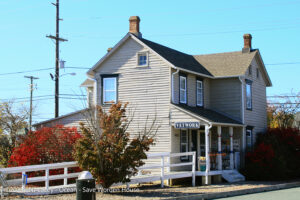 and postmaster Jacob Vaughn, the Worden House is the oldest remaining structure in Lacey Township, a two-and-a-half-story clapboard farmhouse that predates the township’s 1871 incorporation and retains significant historic fabric including six-over-six windows, original chimneys, and decorative porch spindlework. The house holds extraordinary Civil War significance: Vaughn’s sons Gustav and Benjamin survived imprisonment at the notorious Andersonville prison camp, where more than 12,000 Union soldiers perished, and returned to live in the family homestead after the war. The Worden House now faces demolition following Lacey Township’s pending sale of the property for commercial redevelopment, with unofficial plans reportedly calling for a QuickChek convenience store and gas station. Although engineering evaluations confirm the structure is sound and capable of relocation, it currently lacks formal legal protection. Local advocates have initiated litigation to delay the sale while a State Register application is pending.



Gayle Roberts Payne
| 14 May 2026Thank you. It is so sobering to rad of the indifference – how can there be history is nothing is left?
Paul A Carluccio
| 15 May 2026Thank you for putting the 1878 Barn in Ringoes number 1 on your list of endangered historic sites in NJ. As a member of the East Amwell Historic Preservation Committee I have, along with the NJ Barn Company, been advocating for the recognition and documentation of all the historic farm structures in our Twsp for the past several years and hope to establish a Registry with drawings of many of our early barns drawn by Elrich Endersby of the Barn Company who sadly passed last September.
Robert May
| 19 May 2026Help Our Preservation Effort (H.O.P.E.) is hopeful that naming the Cooper House to Preservation New Jersey’s “Top Ten Historic Site Endangered List” (2026) will draw much needed attention to this early post-and-beam structure and help with its restoration. The rear section of the Cooper House dates to the period when the Moravians occupied Hope Village (1769-1808), with two later (early 1800) additions. Thank You Preservation New Jersey!