

- June 20, 2026
- Darren Tobia
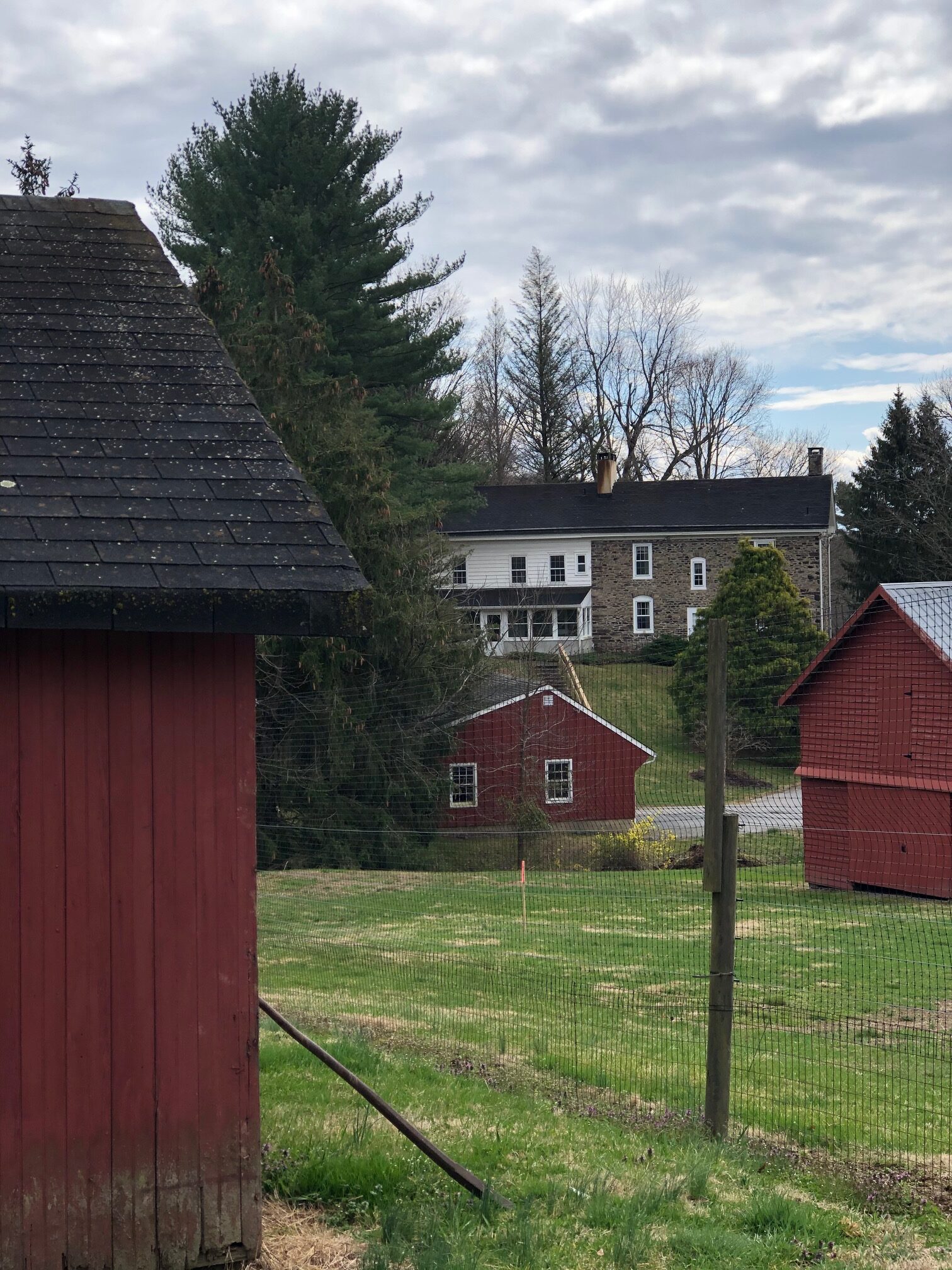
In 2021, the Closson family decided to sell one of the last privately owned farms in Lambertville. The land, known as the Holcombe Farm, is home to rolling meadows and a historic farmhouse. It seemed the perfect plan for the city government to buy the farm and preserve both the land and a beloved local landmark.
Five years since the sale of the farm, there are still many unanswered questions. Although more than five acres will be preserved as open space through Green Acres, the remaining three acres have become enmeshed in a debate about affordable housing. Since the purchase, residents have become concerned about what could happen with the historic structures on the property, which include a barns and an 18th-century home.
Last year, Habitat for Humanity signed an agreement to build a affordable-housing development on one of the parcels. The agreement solved two issues—recouping some of Lambertville’s $3.5 million investment in buying Holcombe Farm and helping to fulfill its state-mandated affordable housing obligation. However, one of the sacrifices of that plan is to potentially demolish a barn built in the 1940s and a log cabin.
The Holcombe Farm is included in the Lambertville Historic District, which is listed on the National Register. There is still some debate about whether the barn is a contributing building, but that is a decision that rests with the State Historic Preservation Office when the project is reviewed, according to Mayor Andrew Nowick.
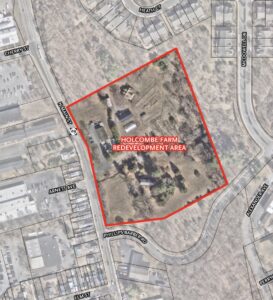
Aerial showing Holcombe Farm. Credit: Holcombe Farm Redevelopment Plan/Clark Caton Hintz.
“We’re nowhere near that level of planning yet,” Nowick said. “I don’t think that’s going to happen this year. Habitat for Humanity has to get the funding in place and these things take a long time.”
The town’s purchase of the Holcombe farm is part of a larger movement in the region to preserve historic farms and prevent developers from turning the sprawling land into subdivisions. In 2006, West Amwell township bought the Fulper Farm to prevent it from becoming 67 homes. Around that same time, Princeton bought the Gulick Farm, including the 1683 Greenland House.
In theory, these types of land acquisitions are wins for both preservationists and open space advocates. It can also bring peace of mind to the nearby residents who fear what could happen if the wrong developer acquires the property, especially in an age if builder’s remedy lawsuits like the one at Lambertville High School, Preservation New Jersey reported.
The challenge lies in how to make the deal work without a heavy burden falling on taxpayers or contributing to the municipal debt.
There have been issues raised among residents about the price the city paid for the land and how much it is being parceled off for. In addition to the deal with Habitat for Humanity, there is another parcel being sold to nonprofit food pantry Fisherman’s Mark, but the appraisal will not be yet made public until the sale is complete.
“It’s our fiduciary responsibility to taxpayers to get as much money as we can for our coffers,” said Council President Benedetta Lambert. “It doesn’t matter if we sell the property to a benevolent organization at a discounted price versus a qualified bidder at a slightly higher price, we would still be able to pay down the debt with the money.”
Last year, the city council passed the Holcombe Farm Redevelopment Plan, which allows the municipal government to choose a redeveloper without a competitive bid, which has also drawn criticism.
“The reason you make an area of redevelopment is so you get around the bidding laws, get around the zoning laws, and you get around everything else,” said resident and well-known environmentalist Jeff Tittel.
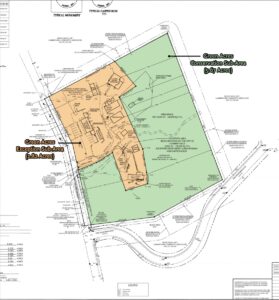
A map showing that 5.67 acres of Holcombe Farm is protected through Green Acres as open space. Credit: Holcombe Farm Redevelopment Plan/Clark Caton Hintz.
The one remaining mystery regarding the Holcombe Farm is what the municipal government intends to do with the property’s most important landmark — the 1709 farmhouse. “We haven’t discussed that as a council,” Nowick said. “I would not wish to have that move out of public hands, but I’m just one vote out of five.”
In 2021, when the Closson’s sold the property, they also gifted a copy of the original 1705 land deed, which is now framed at City Hall. “I look at it every single day. I’m very keenly aware of the historic significance of that site,” Nowick said.


K Suzanne Parsons
| 21 June 2026I love how Pres. Bites add to my knowledge of NJ history, thank you.
John P. Hencheck
| 20 August 2026The Holcombe Farm is listed as a State and National Register historic SITE.The 8.3 acres is the only
remaining of 350 acre purchase in 1705! This is the earliest european decendent settler, the native americans sold in 1703. In the American Historic Building Survey of 1937 has been cleared as a National Historic Landmark SITE. This property subject to legal total encroachment protection! I / wife, founders of LHSociety, authors,researchers Rev.War hunterdon co. Crossroads, Battle Field Protection Act covers SITE. This requires investigation by State/Federal authorities . email me
John Hencheck
| 20 August 2026The Holcombe Farm on the State and National Register as a SITE; all 8.4 acres protected by NJ and Federal Statutes from encroachment which includes viewscape. In the 1937 Hisroric American Building Survey is cleared for a National Historic Landmark Status but blocked by City includes barns