

- September 26, 2026
- Anonymous Author
When some over a certain age hear “Newark,” there is often an unfortunate kneejerk instinct to think “riots.” The “long hot summer” of 1967 has cast a long shadow over New Jersey’s largest city in the popular zeitgeist despite possessing a far greater history and strides made since in escaping the socioeconomic impacts of postwar deindustrialization. Even within the context of that single year alone, it has overshadowed another important place Newark has in the history of American civil rights and race relations. And now the space where that history took place is under threat of disappearing forever.
Black Power
Before the unrest seized the city, Newark had been selected as the location for the National Conference on Black Power—an event scheduled from July 20th to 23rd and featuring talks and workshops with a range of Black community organizers, academics, lawyers, clergy, and many others, all focused on the self-empowerment of Black communities. Among the expected noted figures was Adam Clayton Powell, Jr. (1908–1972), first African American to be elected to Congress from New York. He didn’t make it, but his son, also named Adam, did. So did the popular comedian and activist Dick Gregory (1932–2017). Over 1,000 delegates from 126 cities, representing 286 African American organizations, were in attendance.
None could predict, of course, the specific spasm of violence that would overtake the city just days before, between July 12th and 17th. Some saw it as underscoring the urgent need; others saw the conference as further incitement. There were ardent demands for the recall of then-Mayor Hugh Addonizio over his handling of the riots, with future-mayor Kenneth Gibson (1932–2019) speaking in support.
Despite the tensions, the event passed without incident, and is remembered as seminal to the Black Power movement, planting the seeds for further movements, including the present Black Lives Matter.
Cathedral House
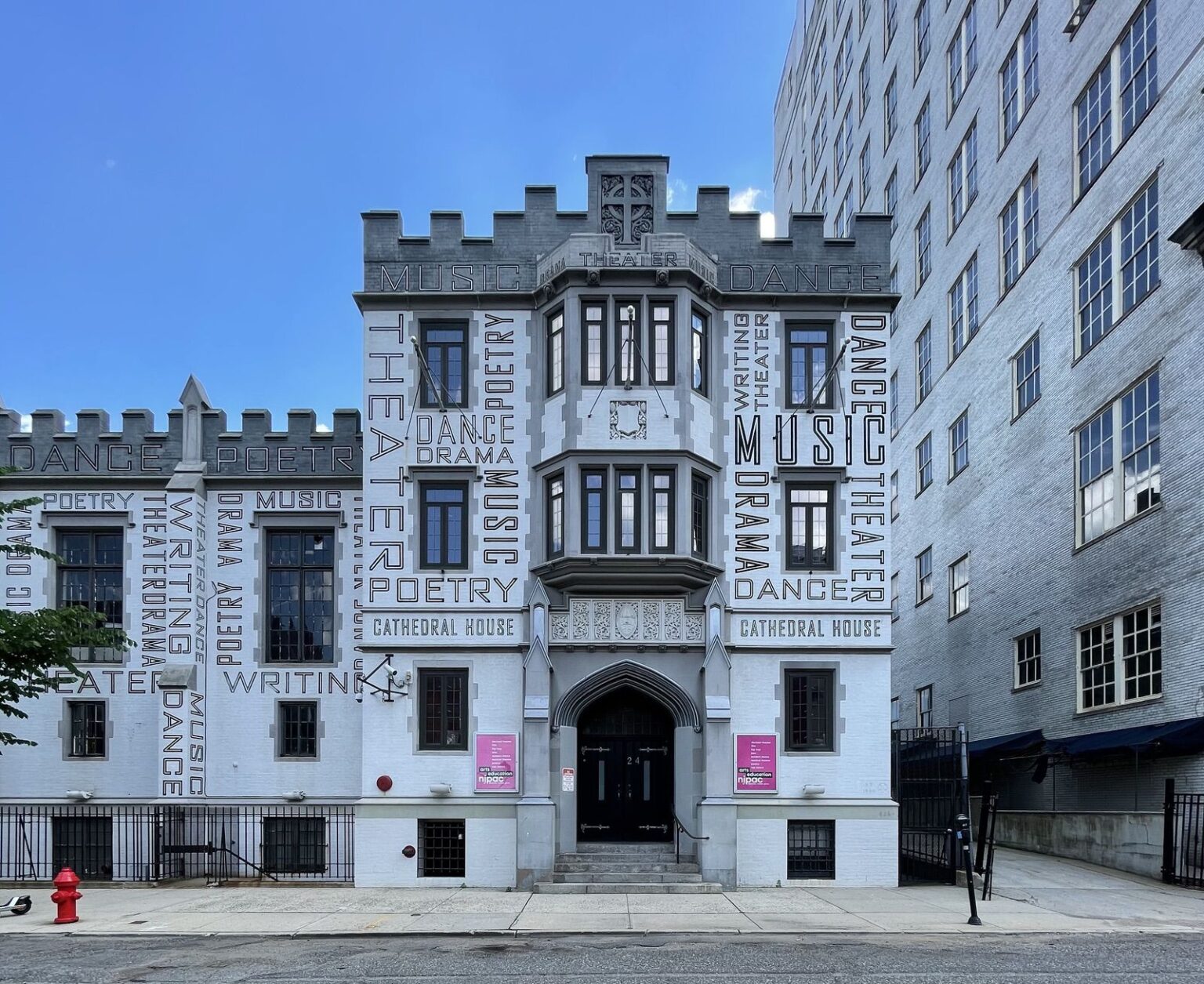
The chairman of the conference was Dr. Nathan Wright (1923–2005), an Episcopal clergyman originally from Louisiana. Steeped in various civil rights organizations, he embraced the Black Power movement by the time he had settled in Newark in 1964, serving with the diocese’s Department of Urban Work. The Department was headquartered at 24 Rector Street, in a building known as “Cathedral House.” While conference activities were also held at Military Park Hotel, it was Cathedral House where the press conferences were broadcast, making the unique building the symbolic public centerpiece for the event in media coverage.
Beyond this role, Cathedral House could be viewed as emblematic of the arc of Newark’s fortunes, from a powerhouse of industry and commerce through social upheaval and postwar deindustrialization, to the city’s present efforts at redevelopment and revitalization that frequently puts preservation in the crosshairs.
It was built as rectory for the Diocese of the Episcopal Church in Newark in 1941, designed by the architectural firm of John H. & Wilson C. Ely. Born in Pennsylvania, John Ely (1851–1932) established his office at Newark in 1885 and was joined by son Wilson (1873–1959) a decade later, and who continued the business after his father’s death. Father and son became leading architects in and around Newark, responsible for some of the city’s most iconic monumental buildings—Newark City Hall, the National Newark and Essex Banking Company, the Firemen’s Insurance Company Building, Mutual Benefit Life, American Insurance Company, and the former New Jersey Historical Society. Wilson Ely himself described their work as “conservatively modern,” which made Cathedral House a unique departure as their only gothicizing work. The name comes from the crenellated parapet and four double-height cathedral windows interspersed between brick buttresses.
During its time owned by the Diocese, Cathedral House included their offices, All Saints’ Chapel (named for a more literal cathedral that was never built), library, kitchen, choir room, and boardroom, plus smaller meeting rooms. It also held an auditorium with a gallery that seated 600, used as the venue for Diocesan Conventions. On the floor below it, there was a full-sized basketball gymnasium with bleachers. It was particularly noted in the local Episcopalian community as having been the personal home of the fifth Bishop of Newark, Benjamin M. Washburn (1887–1966) between 1935 and 1958.
Demographic shifts over the course of the 20th century saw the city’s Episcopalian community shrink, and in 1990, the Diocese sold the building to the New Jersey Performing Arts Center (NJPAC). It assumed a new role in 1999, as an education space where thousands of Newark’s children have been inspired by the power of the arts, through NJPAC’s programs in singing, dance, and acting. Following renovations in 2001, Cathedral House was decorated with exterior murals by graphic designer and painter Paula Scher in her unique style known as “super-graphics,” using words in condensed lettering with black outlines to represent the programs taught within the building. This became a signature environmental graphic for NJPAC, featured in books and exhibited in museums, including the Smithsonian’s Cooper Hewitt Design Museum.
Calls for Demolition from the Start
Despite appearing to be a beneficial asset to NJPAC, almost from the start they evidently considered Cathedral House being on the property as a liability, making the first of three applications for its demolition as early as 1993. This was stopped by a Section 106 review resulting in an agreement that required them to restore and adaptively reuse the building, which they later did as the arts education space. What they did not do, however, was add the “restrictive covenant” clause to the deed that would preclude demolition in the future if the building were sold to another party. Nevertheless, matters went along fine for the next two decades, seeing both the start of the art education programs at Cathedral House in 1999 and the 2001 renovation.
In 2004, the Military Park Historic District was established, which includes Cathedral House as a contributing property. Other lots used for surface parking, greenery, and plaza space, however, were excluded by the Landmarks & Historic Preservation Committee (LHPC), and preservation advocates still question why, seeing in it the roots of the current situation.
Demolition was again on the table by 2022, when the LHPC received NJPAC’s next campus development application. Their argument centered on a reduced ability to accommodate the large trucks commonly used to transport performance equipment. Previous development between NJPAC and Cathedral House, including cutting through a new street, limited truck parking—and revenues from hosting larger productions.
This argument was rejected by the LHPC, however, citing that the full demolition they proposed did not meet the standards set by the Zoning Ordinance regarding demolitions in a historic district. Ultimately, thanks to public pressure, an agreement was reached to preserve the square footprint of the front half of Cathedral House, and integrate the remaining smaller building into the development. This compromise meant it would be actively used and incorporated into the project programmatically. At the time, this was considered a major preservation win.
By 2025, however, demolition was yet again being proposed, this time with Cathedral House being replaced by a small memorial park, commemorating its role in the history of the Black Power movement. The rationale for demolition now shifted from logistics to the claimed prohibitive costs of asbestos abatement. Preservationists see this as a weak argument on two points. Even a small park still carries the ongoing expenses of maintenance and security. Moreover, asbestos abatement would still be required with demolition, meaning it is not sufficient justification for demolition on its own.
The overall argument of financial hardship appears to be undercut by the fact NJPAC was able to secure funding for the preservation of the nearby Episcopal Diocese House at 31 Mulberry Street. This structure is of comparable size and presented similar environmental hazard challenges.
The cost of the ongoing 2022 campus expansion was put at $250 million. Advocates reject NJPAC CEO John Schreiber’s claim that adaptive reuse of Cathedral House constitutes an unreasonable financial hardship. By his own estimates, it would cost $1 million—an amount preservationists point out represents less than 1% of the total $250 million project, funds for which partially come from taxpayer sources.
While these weakness in the arguments were pointed out by the public repeatedly over the course of two LHPC hearings, NJPAC has maintained the position total demolition is the only option. Preservation advocates reject the idea that the arguments given in the 2022 or 2025 applications are supported by the local ordinance as valid reasons to demolish a contributing building in a historic district.
During the January 2026 hearings on the matter, NJPAC made a verbal agreement to add a prohibition to the deed against anything else being built on the Cathedral House site. Preservationists point out, however, that this has yet to be formalized in writing as a condition of LHPC approval. Meaningful enforcement of this deed restriction would require coordination across multiple departments at City Hall, including Zoning and Planning, and sustained over multiple decades to ensure the restriction holds.
Advocacy and Allegations
As of early 2026, demolition permission has been granted by the Newark LHPC. The current preservation advocates (who, it should be noted, were unwilling to be publicly quoted in this article) are especially critical of personnel changes made in recent years to the Commission by the City that are viewed as an alleged effort to make it overly sympathetic to developer interests. Procedural criticisms have been expressed over how the Commission arrived at their decision to accept the hardship claim. They allege ad hoc criteria were created while ignoring established permissible criteria. Local Zoning Ordinance establishes acceptable criteria for evaluating demolition applications in a historic district. Advocates assert neither the 2022 nor the 2025 applications meet that criteria.
The Commission also found that the 1993 and 2022 agreements were invalid and therefore unenforceable. Advocates claim the LHPC does not have the authority to find prior agreements invalid, and its own decisions are subject to challenge via the Zoning Board. The LHPC is not a court of law and, unlike the Zoning and Planning boards, the LHPC serves an advisory role, which means their decisions are not legally binding. This impacts the 2022 decision. The 1993 agreement is a much more complex (and definitely legally binding) agreement, as it involved government entities beyond LHPC.
Perhaps most seriously, some preservationists have accused Commission members who voted to approve demolition of alleged conflicts of interest that were not acknowledged. Although one member did recuse themselves from voting, they were still permitted to voice their opinions and influence those who cast votes. Local advocacy group Newark Landmarks, which leads the current efforts, has filed a formal complaint with the State Ethics Commission regarding these allegations, which is currently under review.
More broadly, the preservationists see a bad precedent being set if such bodies are allowed to invalidate Section 106 agreements without legitimate cause. Such agreements are a key tool used by historic preservation communities nationwide—one they believe is being undermined in Newark.
What’s Next?
Despite being the most populous city in the Garden State with over 300,000 people, Newark has no dedicated newspaper of its own anymore, digital or printed. Preservation advocates lament how this hinders public oversite of government doings in general, but particularly when it comes to the impact of development on historic preservation. Getting the word out about Cathedral House is made all the more difficult. Nevertheless, there could still be time for an eleventh-hour reprieve if enough people can be reached.
The demolition of Cathedral House is essentially a three-step process. Landmarks and Historic Preservation Commission approval of the January 2026 application was the first. Preservationists have been looking to the post-demolition plans for a possible regulatory argument. The current understanding of the proposal is for the property to be converted into the aforementioned memorial park with an area for surface parking. Such use is not permitted in downtown Newark, meaning a variance would be needed from the Zoning Board of Adjustments, in the next step of the process. Should that variance request be rejected, demolition becomes moot. The last step would be final site plan approval by the City’s Central Planning Board. While the clock is definitely ticking, these processes naturally take time, which preservation activists hope to make the most of.
The Newark Landmarks group is leading the opposition and is the largest historic preservation organization in the City. They are joined by the James Street Commons Historic District, Forest Hill Neighborhood Association, and Friends of Mount Pleasant Cemetery. Cathedral House has also caught the attention of local and state news outlets. Preservation advocates urge the public—both inside and outside of the City—to express their concerns to the Newark Municipal Council and Planning Board, as well as the state Department of Community Affairs. While such local resident-based advocacy is the heart of the effort and focus attention on the City’s Landmarks and Historic Preservation Commission, the nature of NJPAC itself offers possible pressure points from beyond the city border.
NJPAC’s own website self-describes it as “the anchor cultural institution for the city of Newark and the state of New Jersey.” It has attracted world-renowned performers since the theater complex opened in 1997 and been considered an important component in the revitalization of Newark’s downtown. That role rests in no small measure on maintaining community good will, public trust, and a good reputation throughout the state and beyond—and, critically, the fundraising dollars that inspires. Further, NJPAC CEO John Schreiber is expected to retire in mid-2027, and his legacy risks being tarnished, depending how the organization’s supporters view his actions on this issue if it is pushed to the fore.
Cathedral House is emblematic of everything from the City’s Episcopalian heritage to Civil Rights history to the role of the arts in revitalizing communities. NJPAC has played an important role in Newark moving out from the long shadow cast by the “long hot summer of ’67,” and has now a chance to strengthen its place in the community by preserving a poignant part of that story.


Janet Foster
| 27 September 2026The article on the Cathedral house is the best piece of writing about an endangered property I have read. Kudos to the author; and kudos to the Newark community who are advocating for its preservation. But big demerits to NJ PAC for not responding to the history & culture that existed before them.