
- October 6, 2026
- Kelly C. Ruffel
When we hear the name Gustav Stickley, we tend to picture Craftsman furniture, warm wood interiors, exposed joinery, and the comfortable Arts and Crafts bungalow. Stickley’s influence on American domestic design is difficult to overstate. Through The Craftsman magazine, his Home Builders Club, published house plans, furniture, and other ventures, he helped popularize an ideal of domestic life centered on simplicity, craftsmanship, flexibility, and a closer relationship between buildings and the natural environment.
But what happens when we take Stickley out of the house?
That question is at the center of the Stickley Museum at Craftsman Farms’ Fall 2026 virtual lecture series, “Anti-domestic: An Alternative Architectural History of Gustav Stickley.” Across six lectures this fall, the series examines a side of Stickley’s architectural story that is often overshadowed by the Craftsman house.
Instead of concentrating exclusively on domestic interiors and suburban homes, Anti-domestic considers the factories, prisons, office buildings, transportation networks, lumberyards, commercial properties, and other spaces that made Stickley’s work possible.
It is a fascinating change in perspective and one that offers an important lesson for preservationists.
Beyond the Bungalow
Stickley became closely associated with the single-family home because he actively promoted an architectural philosophy for American domestic life. His publications offered readers not simply furniture and house plans, but an entire vision of how people might live.
Yet Stickley himself occupied a much more complicated architectural world.
He was a designer, certainly, but he was also a manufacturer, publisher, entrepreneur, employer, property owner, and businessman operating within the rapidly industrializing landscape of Progressive-era America.
His furniture depended upon factories and manufacturing systems. His publications depended upon commercial and distribution networks. His businesses occupied urban properties. His materials moved through lumberyards and transportation corridors. Even Craftsman Farms, perhaps the place most closely associated with Stickley today, complicates our assumptions about his domestic philosophy.
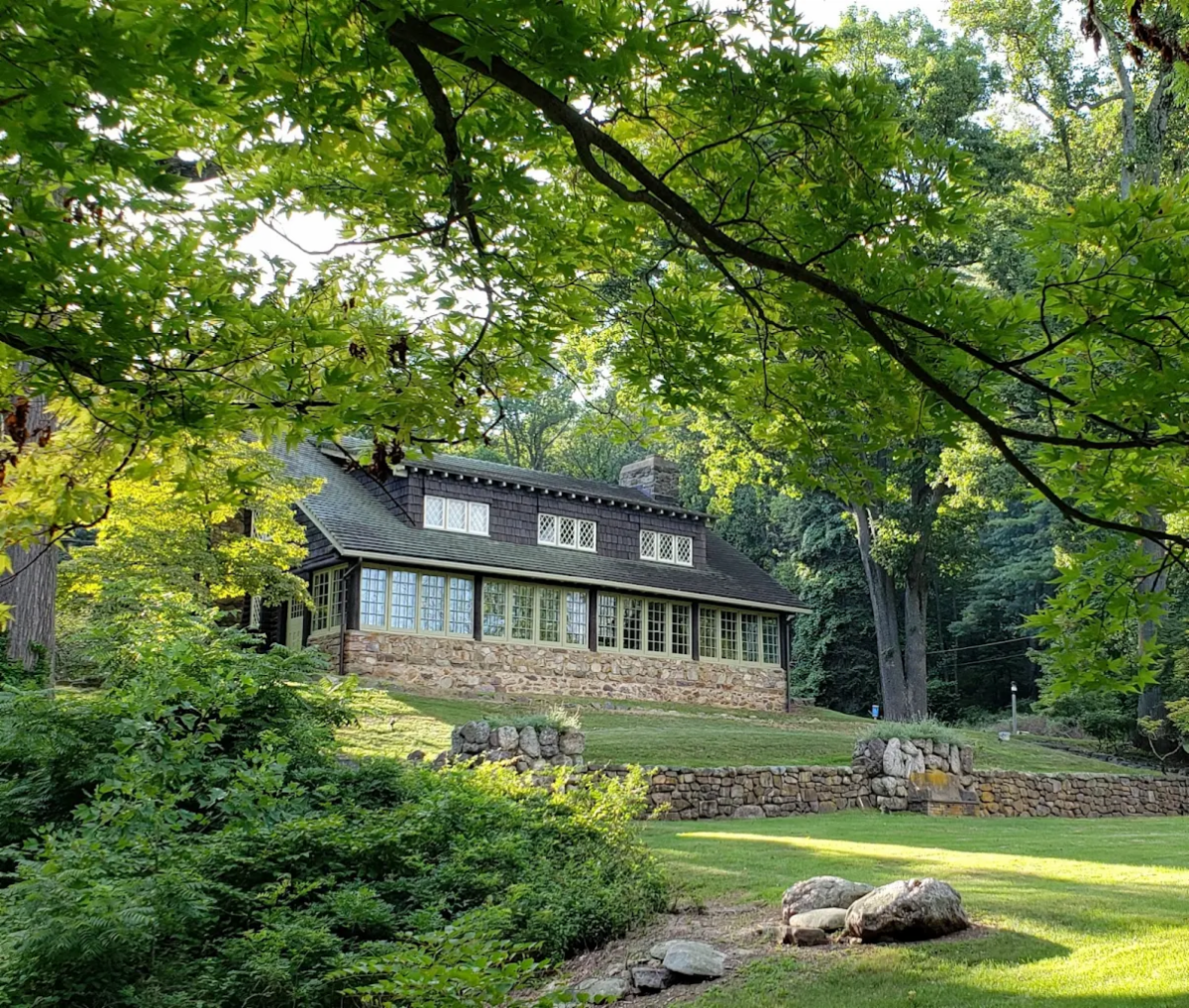
The famous Log House in Morris Plains was conceived not simply as a private residence, but as a lodge: a communal gathering place within Stickley’s larger vision for the property. Looking at these places together reveals a Stickley who cannot be understood solely through the romantic image of the handcrafted home.
The Architecture Behind the Craftsman Ideal
The six-part series begins October 10 with “Convict-Laborer-Craftsman: Stickley’s Prison Problem,” examining Stickley’s relationship to furniture production at Auburn State Prison.
“Factory Made: The Industrial Spaces of Gustav Stickley” turns toward the manufacturing environments necessary to produce objects that celebrated craftsmanship.
“The Tall Office Building Craftily Considered: Stickley’s Property in Manhattan” moves into the urban landscape, examining Stickley as a property owner within the modern metropolis.
For New Jersey audiences, “The ‘Lodge’ House: Rustic Visions in Suburban New Jersey” provides an opportunity to reconsider Craftsman Farms and the Log House within this broader architectural story.
The final lectures move beyond individual buildings altogether. “The Interlinked Land: Trains and Transit” examines the infrastructure connecting Stickley’s enterprises, while “The Craftsman House Migrates” explores how builders, plan books, and others carried Craftsman ideas far beyond Stickley’s own projects.
Together, these topics challenge us to think about architecture not as a collection of isolated buildings, but as part of interconnected systems of labor, commerce, transportation, materials, property, and people.
Why This Matters for Historic Preservation
There is a larger preservation lesson here.
Historic preservation has traditionally been very good at recognizing the architectural object: the significant house, exceptional building, landmark interior, or work associated with a famous architect or designer.
Factories tell us how celebrated objects were actually manufactured. Transportation corridors explain how materials and people moved. Commercial buildings reveal the economic networks behind design movements. Workplaces expose questions about labor and production that may be invisible within a beautifully preserved interior.
Sometimes the buildings that appear least glamorous are precisely the places that help us understand the celebrated landmark.
That broader approach is increasingly important to preservation. Saving a historic place should not mean freezing a single interpretation of its significance. Research can and should continue to complicate the stories we tell about familiar people and places.
Stickley provides an especially interesting case. The Arts and Crafts movement often emphasized authenticity, handcraftsmanship, simplicity, and resistance to some of the perceived excesses of industrial society. Yet bringing those ideals to a national audience required Stickley to participate in the very industrial, commercial, and transportation systems that characterized modern America.
That contradiction does not diminish his significance. It makes the history richer.
Rather than seeing Stickley only as a visionary Arts and Crafts designer, Anti-domestic invites audiences to consider him as a person navigating the complicated realities of entrepreneurship, property ownership, manufacturing, labor, and modernization in Progressive-era America.
And that is one of preservation’s most valuable roles: not simply protecting beautiful buildings, but using places to ask better questions about how people actually lived, worked, built, traveled, and shaped the world around them.
Fall 2026 Virtual Lecture Series
Anti-domestic: An Alternative Architectural History of Gustav Stickley
Presented by the Stickley Museum at Craftsman Farms
October 10, 1–2 p.m. EDT
Convict-Laborer-Craftsman: Stickley’s Prison Problem
October 17, 1–2 p.m. EDT
Factory Made: The Industrial Spaces of Gustav Stickley
October 24, 1–2 p.m. EDT
The Tall Office Building Craftily Considered: Stickley’s Property in Manhattan
November 7, 1–2 p.m. EST
The “Lodge” House: Rustic Visions in Suburban New Jersey
November 14, 1–2 p.m. EST
The Interlinked Land: Trains and Transit
November 21, 1–2 p.m. EST
The Craftsman House Migrates: Workaday Builders, Plan Book Makers, and the Craftsman Legacy
All programs are presented virtually via Zoom. Participants may register for individual lectures or the complete six-part series.
Learn more and register:
https://www.stickleymuseum.org/fall-2026-lecture-series/